A Marketer's Guide to Cookieless Attribution
Ever looked at your CRM and seen leads pop up with absolutely no source information? It's a maddeningly common problem for marketers. This is where cookieless attribution comes in—it’s the modern way to figure out which marketing channels are actually working, without having to lean on the crumbling foundation of third-party cookies.
Why Your Marketing Data Is Disappearing

If you feel like you're flying blind with your marketing data lately, you’re definitely not alone. The data we all used to rely on is getting less and less accurate every single day.
Think of it like an old-school store owner. They run ads in the local paper and hand out flyers on the street, but when a customer walks in, they have no clue what brought them there. For years, third-party cookies were our digital equivalent of asking, "How did you hear about us?" But that era is officially coming to an end.
This isn’t some far-off problem; it's hitting marketers right now. Big browser updates, a huge cultural shift toward privacy, and new regulations are pulling the plug on the old way of tracking.
The Forces Behind the Shift
The move away from third-party cookies isn't happening in a vacuum. It’s being driven by a perfect storm of consumer demand for privacy and real-world regulatory pressure. The result? The old-school methods for tracking a user's journey across different websites are simply breaking down.
Here's what's causing the change:
- Browser Privacy Updates: Browsers like Safari and Firefox have been blocking third-party cookies by default for a while now.
- Regulatory Pressure: Laws like GDPR in Europe and a growing number of U.S. state-level acts are putting strict rules on how companies can collect and use customer data.
- Consumer Awareness: People are more savvy than ever about online tracking. They're actively using ad blockers and privacy tools to take back control of their data.
By mid-2026, Google will have completely phased out third-party cookies in Chrome, which impacts billions of users worldwide. But the "cookieless future" is already here. Right now, 34.9% of US browsers block cookies by default, and 20 US states have strict privacy laws on the books. This means your ability to do granular cross-site tracking for things like retargeting and understanding complex multi-touch journeys is severely limited. For a deeper dive, check out this detailed report on the cookieless future from Ascensor.
The core issue is that third-party cookies, which acted like cross-site trackers, are being phased out. This breaks the link between an ad a user saw on one site and a conversion they made on another, leaving a huge gap in attribution data.
Let's quickly compare the old and new ways of thinking about tracking.
The Shift from Cookie-Based to Cookieless Tracking
This table gives a quick snapshot of why traditional tracking is failing and what makes newer, cookieless methods more reliable for the long haul.
| Tracking Aspect | Old Way (Third-Party Cookies) | New Way (Cookieless Methods) |
|---|---|---|
| Data Source | Relies on cookies placed by external domains (e.g., ad networks). | Uses first-party data, server-side logs, and privacy-safe models. |
| User Consent | Often implicit or buried in complex consent banners. | Requires explicit, clear consent, putting the user in control. |
| Accuracy & Reliability | Increasingly blocked by browsers, leading to massive data gaps. | More resilient to blockers and privacy settings, providing a fuller picture. |
| Cross-Device Tracking | Very difficult; struggled to connect a user across phone, laptop, etc. | Can connect user journeys across devices through unified customer profiles. |
| Privacy Focus | Tracked users across the web, often without their full knowledge. | Prioritizes user privacy by design, focusing on owned data. |
As you can see, the shift is about more than just technology; it's a fundamental change in how we respect user privacy while still getting the insights we need.
This guide will walk you through exactly what cookieless attribution is and why it's so important to get on board now. By understanding these new methods, you can get your data back, accurately measure your ROI, and start making smarter decisions to grow your business.
Understanding Why Cookies Are Crumbling

To really get why we're all talking about a "cookieless" future, you first have to know that not all cookies are created equal. For years, they've been the bedrock of how the internet works, but one type has caused a world of trouble.
Think of first-party cookies as your website's personal memory. They’re the good guys, remembering a user’s login info, their language preference, or what’s in their shopping cart. They’re created by your own site for your users' convenience and make for a much smoother experience.
Third-party cookies, on the other hand, are the ones causing all the fuss. These are tracking files placed on a user's browser by a company other than the one they're visiting—usually an advertising platform. Their job is to follow people from site to site, piecing together a detailed profile of their interests and online behavior.
The Privacy Pushback
It’s that cross-site tracking that finally sparked a massive backlash from everyday users and regulators. People grew tired of feeling like their every click was being monitored and monetized without their permission. That feeling turned into a movement.
This demand for privacy is the single biggest reason third-party cookies are on their way out. Big tech and governments listened, and their actions have completely reshaped how online tracking is allowed to work.
The real problem was that third-party cookies fueled an entire industry built on surveillance. Once users demanded more say over their own data, the technology that made it all possible was destined to be dismantled.
Browsers and Regulations Lead the Charge
The death of the third-party cookie wasn’t a single event—it’s been a slow-motion demolition carried out by the biggest players in the tech industry. This shift has left a lot of old-school marketing attribution models broken.
Here’s a quick rundown of the major milestones:
- Apple's ITP: Years ago, Safari's Intelligent Tracking Prevention (ITP) started aggressively blocking third-party cookies, which was a huge first step.
- Google's Chrome Phase-Out: When Google announced it would phase out third-party cookies in Chrome—the world's most popular browser—it was the final nail in the coffin.
- Privacy Legislation: Landmark laws like GDPR in Europe and CCPA in California gave people legal control over their data. These regulations put the responsibility on businesses to get clear consent. If you want a deeper look at the rules, you can learn more about things like implementing WordPress cookie consent.
For marketers, this means the data trail we once relied on is now full of gaps. You can no longer count on an old tracking cookie to tell you that a click on a social media ad led to a sale on your website. This is why so many of us feel like we’re flying blind, and it’s exactly why we need a new approach like cookieless attribution.
Diving Into Modern Cookieless Attribution Methods
With third-party cookies on their way out, a smarter, more reliable toolkit has emerged for tracking marketing success. These new methods don't rely on tracking people across different websites. Instead, they focus on data you own and control, giving you a much clearer picture of your customer’s journey from start to finish.
The real goal here is to connect the dots—from the ad someone clicked to the lead that finally landed in your CRM. Let’s break down the most effective cookieless techniques that make this possible, all in simple, non-technical terms.
First-Party Data: The New Gold Standard
In this new era, your most valuable asset is your first-party data. This is all the information you collect directly from your audience with their permission—think email sign-ups, form submissions, or purchase histories. It’s trustworthy, accurate, and best of all, it's completely yours.
Unlike the old third-party data that was bought and sold, first-party data is all about building a direct relationship. By focusing on this, you're not just playing by the privacy rules; you're building a more sustainable and ethical foundation for your marketing that actually respects people's trust.
Server-Side Tracking: Your Direct Data Pipeline
Imagine your website's tracking pixel trying to send a message to Google Analytics, but an ad blocker gets in the way. Server-side tracking basically creates a direct, private line of communication to bypass these kinds of roadblocks.
Instead of data going from a user’s browser straight to a platform like Meta or Google, it goes to your own server first. Your server then securely passes that information along to your marketing and analytics tools. This simple change dramatically improves data accuracy because it isn't derailed by browser restrictions or ad blockers.
For instance, marketers using server-side tracking with Meta's Conversions API (CAPI) have been able to "find" a massive number of conversions that were previously invisible. Some reports show this can boost reported revenue in Ads Manager by 20-30%, just by capturing data that pixel-only setups were missing.
Modeled Attribution: Filling in the Blanks
Even with the best tools, you’ll always have some data gaps. That’s where modeled attribution comes in. It uses machine learning and smart statistics to make educated guesses that fill in the missing pieces of the customer journey.
Modeled attribution looks at the conversion data from users who agreed to be tracked and applies those patterns to estimate the behavior of users who didn't. It's a privacy-friendly way to get a much more complete view of how your campaigns are really doing.
Platforms like Google Analytics 4 already do this to report on conversions they can't directly see. As you explore modern cookieless attribution methods, understanding various multi-touch attribution models can provide a more holistic view of customer journeys.
UTM Hygiene: The Foundation of It All
Finally, none of these advanced methods mean a thing without a clean foundation. UTM parameters—those little tags you add to the end of your URLs—are still one of the most powerful tools in your entire attribution kit.
Keeping your UTMs organized and consistent is non-negotiable. This means having a clear, disciplined naming system for your source, medium, and campaign tags. When every link is tagged correctly, your analytics can trace every click back to its origin, giving you clean, reliable data that fuels your entire cookieless strategy. For a deeper look into this topic, you might be interested in our guide to multi-channel attribution modeling.
How to Set Up Cookieless Tracking (Without Touching a Line of Code)
Shifting to cookieless attribution sounds technical, but it doesn't have to be. For marketers who aren't developers, the secret is finding a modern tool built to handle the entire process for you.
The whole approach is actually quite simple. A good "set-and-forget" tool will automatically capture first-party data and UTM parameters from every single visitor session. Think about it—it logs where they came from (like Google Organic Search or a LinkedIn ad) and tracks their path through your website.
When that visitor eventually fills out a form, the tool seamlessly passes all that attribution data into hidden fields. This is the most important part. It creates a direct connection between their first marketing touchpoint and the moment they became a lead.
How a No-Code Workflow Actually Works
This method means you can skip the headaches of setting up complex configurations in Google Tag Manager or writing custom scripts. It's designed to work right out of the box with the forms you already have, whether that’s Typeform, Gravity Forms, or the native forms on your Webflow site.
The big idea is to enrich every lead before it lands in your CRM. Instead of leads popping up as "source unknown," they arrive with a full backstory on how they found you.
This chart breaks down the simplified flow of how first-party data gets from the user to your CRM, all without relying on cookies.
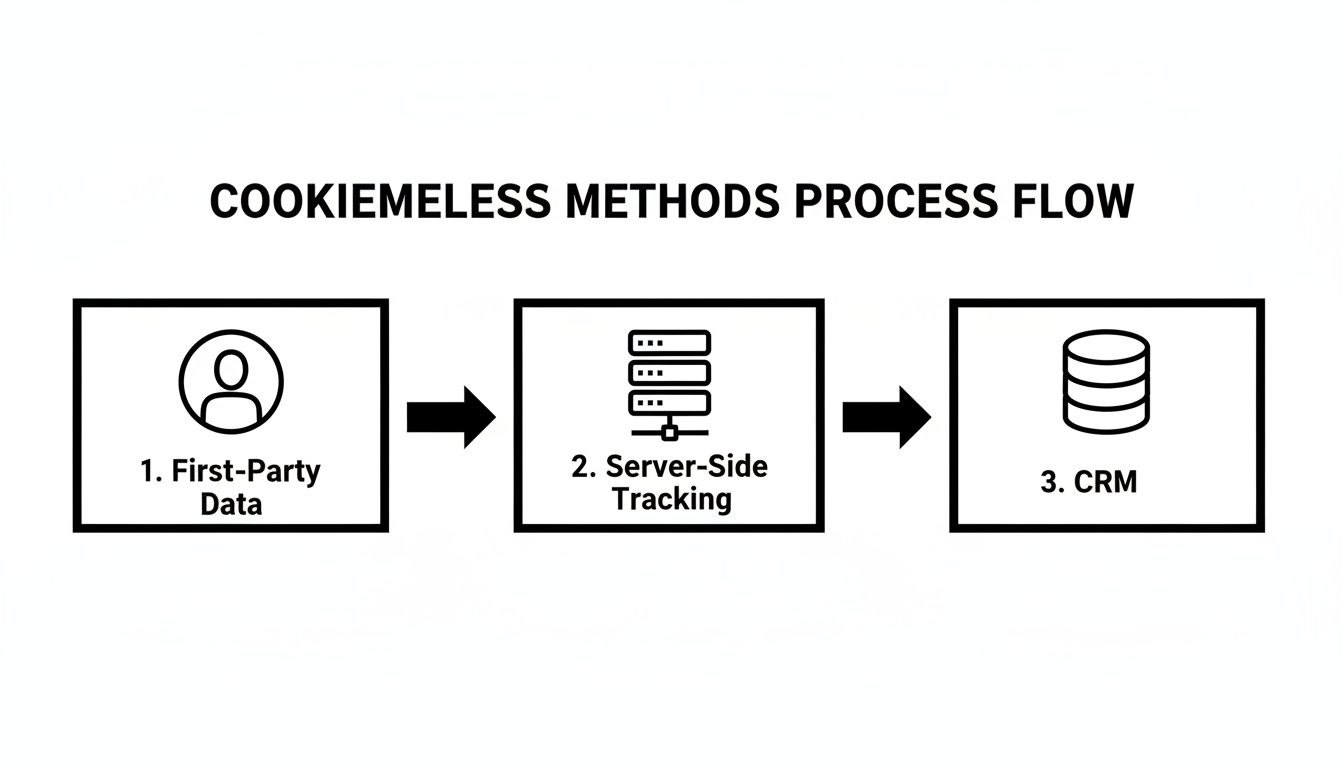
As you can see, it’s a direct line from user interaction to your database, which helps maintain data accuracy by sidestepping any browser-based tracking blockers.
Capturing the Right Data on Autopilot
What makes a system like this so powerful is the quality of the data it collects automatically. It’s not just grabbing UTMs from your paid ads; it’s smart enough to figure out the source for all your traffic.
Here’s a quick look at the kind of data a no-code tool can capture for you:
- Channel: The specific marketing channel that brought the visitor (e.g., Paid Social, Organic Search, Referral).
- UTM Parameters: It automatically stores all the standard UTM tags from your campaign links.
- Landing Page Data: It records the very first page a user landed on, plus the URL of the page where they submitted their form.
This automatic capture is what makes cookieless attribution truly work for non-technical teams. It ensures that 100% of your leads get attributed, not just the ones from your meticulously tagged paid campaigns.
With this data flowing directly into your CRM, you can finally build reports that show which channels are driving the most leads, customers, and—most importantly—revenue.
To get a better sense of the mechanics, you can learn more about how to implement this by reading our guide on using hidden fields in your forms. This simple, automated approach finally closes the loop on attribution for good.
Your Future Is Built on First-Party Data
So, what does all this mean for you? It’s actually pretty simple. The future of marketing belongs to businesses that learn to use their own first-party data effectively and ethically.
The slow death of third-party cookies isn't a disaster to panic about. Think of it as a huge opportunity to build a more transparent, reliable, and honest marketing system from the ground up.
When you switch to a cookieless attribution model, you're not just plugging a hole in your analytics. You're fundamentally upgrading your entire data strategy to be more accurate, more resilient, and way more respectful of your customers' privacy.
The Benefits of a Cookieless Approach
Moving to a modern attribution model gives you clear, measurable advantages that go way beyond fixing a few broken reports. It's about making smarter decisions that directly grow your business.
Here’s what you stand to gain:
- Truly Accurate Data: By focusing on data you collect yourself and server-side tracking, you get a much sharper picture of which channels are actually driving revenue.
- Stronger Privacy Compliance: Cookieless methods are built to play by the rules of regulations like GDPR and CCPA, which means fewer legal headaches for you.
- Increased User Trust: When you stop using creepy cross-site trackers, you send a clear message to customers that you respect their privacy. That’s how you build real, long-term brand loyalty.
This shift finally gives you the power to see the entire customer journey. You can understand how different touchpoints work together and confidently put your budget into the channels that deliver the best results. For a closer look at connecting marketing activities to tangible outcomes, check out our complete guide on marketing lead tracking.
The core message here is one of empowerment. You don't need to be a developer or a data scientist to get sophisticated attribution anymore. The right tools can automate the heavy lifting, making data-backed decisions accessible to everyone on the team.
Moving Forward with Confidence
At the end of the day, the goal is to stop guessing. You want to know that your marketing dollars are working hard for you.
With a tool like LeadPulse, you can put a ‘set-and-forget’ solution in place that automatically pipes clean attribution data directly into your CRM and web forms.
This means every single lead shows up with its origin story attached, letting you draw a straight line from your marketing spend to real business growth. By embracing a cookieless future, you’re not just adapting to change—you’re building a stronger, more sustainable marketing engine for your company.
Common Questions About Cookieless Attribution
Thinking about moving to a new way of tracking can feel overwhelming. It’s a big shift, I get it. But the good news is that most of the common worries are easily handled by the tools available today. Let's walk through some of the questions I hear most often from marketers making the switch.
Do I Need to Be a Developer to Set This Up?
Not at all. While the technology behind some cookieless methods can get pretty deep into the weeds, a new wave of tools has been built specifically with marketers in mind. Many of them are truly 'set-and-forget.'
Typically, you just add a small snippet of code to your website one time—that's it. From there, the tool does all the heavy lifting, automatically grabbing attribution data and piping it straight into your forms and CRM. You don't have to manage anything technical day-to-day.
The whole point of modern cookieless attribution tools is to make powerful tracking simple. They're designed to give marketers the data they need without ever having to touch a line of code after the initial setup.
Will This Work with My Existing Forms and CRM?
Yes, absolutely. The best tools on the market are designed to be team players. They integrate smoothly with the platforms you already rely on every single day.
This means they work with the most common form builders and CRMs. The attribution data just gets tacked on as extra, valuable information to the leads you're already collecting. It enriches your current workflow instead of blowing it up.
- Form Builders: Works with tools like Gravity Forms, Typeform, and Webflow Forms.
- CRMs: Integrates with platforms like HubSpot, Salesforce, and Pipedrive.
This plug-and-play compatibility means you can level up your marketing stack without a massive, disruptive overhaul.
Is Cookieless Tracking Compliant with Privacy Laws?
For the most part, yes. Methods that depend on first-party data are in a completely different league, privacy-wise, than the old third-party cookies that followed users all over the internet.
First-party data is information that a user knowingly gives you or that's created from their direct activity on your website. Since these newer approaches don't share user data with a bunch of unknown third parties, they align much better with the spirit of privacy laws like GDPR and CCPA. Focusing on your own data not only builds trust with your audience but also keeps your compliance headaches to a minimum.
How Is This Different from Just Using UTMs?
This is a great question. Think of UTM parameters as a crucial ingredient, but not the whole recipe. They are fantastic for tracking clicks from specific campaigns you've tagged yourself, like a Google Ad or a link in your email newsletter.
But relying on UTMs alone leaves huge blind spots. They can't tell you anything about leads from some of your most valuable channels.
A real cookieless attribution tool captures UTMs when they're present, but its job doesn't stop there. It also identifies the source for every other visitor—giving you a clear view of where 100% of your leads originate. This includes essential channels like:
- Organic Search: Someone who found you through a good old-fashioned Google search.
- Direct Traffic: A person who typed your website address straight into their browser.
- Organic Social: A lead who clicked through from a standard, non-paid post on LinkedIn or Twitter.
- Referral Traffic: A visitor who followed a link to your site from another website or blog.
This complete approach ensures no lead falls through the cracks, giving you the full, accurate picture you need to make genuinely smart marketing decisions.
Stop guessing where your leads are coming from. LeadPulse provides a true 'set-and-forget' solution that sends complete marketing attribution data into your CRM and other tools, so you can finally see which channels are driving real revenue. Get started today at https://getleadpulse.com.
Solving Marketing Attribution Challenges for Good
Struggling with marketing attribution challenges? This guide breaks down the most common problems and offers practical solutions to see your true ROI.
Discover the customer journey report: map ROI across channels
Discover a practical guide to building a customer journey report that ties marketing channels to revenue and boosts ROI—no complex code required.