A Simple Guide to Multi Channel Attribution Modeling
Let's be honest: Multi channel attribution modeling is just a way of figuring out which of your marketing efforts actually deserve credit when a customer interacts with your brand in a dozen different places before they finally convert.
It’s about moving past the lazy habit of blaming "Direct" traffic for every lead and, instead, seeing the entire story of how that customer found you.
Why Your Marketing Data Is Lying to You

Does this sound familiar? You're pouring time and money into social media ads, SEO, and email campaigns. The engagement numbers look great. But when you peek inside your CRM, almost every new lead is tagged as 'Direct' or 'Unknown.'
This isn't just bad luck—it's a classic symptom of broken tracking. Most basic analytics tools only see the very last thing a person did before converting. This is called "last-click" attribution, and it's a deeply flawed way to measure performance.
It’s like giving all the credit for a championship win to the player who scored the final goal, completely ignoring the assists, the defense, and the smart plays that set up the shot in the first place.
The Problem with Last-Click Attribution
In today's world, where a customer might see you on five different platforms, relying on last-click creates massive data blind spots. It completely misses the big picture, and that leads to some really bad marketing decisions.
When you can't see the full journey, you might slash the budget for a channel that's a powerhouse for introducing new people to your brand, all because it rarely gets that final, glorious click.
The breakdown usually happens somewhere between your website forms and your CRM. A real-world customer journey might look like this:
- They first discover your brand through a LinkedIn ad.
- A week later, they find and read one of your blog posts via a Google search.
- Finally, they click a link in your email newsletter and fill out your contact form.
Without proper multi channel attribution modeling, your CRM would probably just credit the email. The ad and the blog post, which did all the heavy lifting, get completely ignored. We dive deeper into connecting these dots in our guide on effective lead source tracking.
Seeing the Complete Customer Journey
Think about it. You run Facebook ads, post on LinkedIn, and publish SEO content. A lead fills out a form, gets zapped into HubSpot, but all that valuable source information just vanishes into thin air. It’s a daily frustration for so many marketers.
This is exactly why a huge 75% of companies have already moved to multi-touch attribution models. They're tired of guessing. According to Ruler Analytics, they're making the switch to get a truly accurate picture of what's driving growth.
By only looking at the last interaction, you are making decisions with incomplete data. Multi-channel attribution isn't just about getting more data; it's about getting the right data to prove your ROI and make smarter budget allocations.
Ultimately, seeing the complete customer journey is the only way to confidently answer the most important question in marketing: "What's actually working?"
What Is Multi-Channel Attribution Modeling?

Imagine your marketing efforts are a soccer team trying to score a goal. The player who kicks the ball into the net gets their name on the scoresheet, but what about the midfielder who made the perfect pass, or the defender who won the ball back to start the attack?
Multi-channel attribution modeling is how we give credit to every player involved in the goal, not just the final scorer.
In marketing, it’s a way to figure out which channels and campaigns actually helped lead to a conversion. Instead of giving 100% of the credit to the very last ad or email a customer clicked, this approach looks at the entire journey and assigns value to each interaction along the way.
It’s a huge shift from a simplistic, last-click view to a complete picture of how all your marketing channels work together to get results.
A Few Key Ideas to Know
Before we dive deeper, let's get on the same page with two core concepts: touchpoints and conversion paths. They sound a bit technical, but the ideas are simple.
Touchpoints: These are all the individual interactions someone has with your brand before they convert. Think of them as every "touch" in that soccer game—the pass, the dribble, the shot. In marketing, a touchpoint could be seeing a Facebook ad, clicking a Google search result, opening an email, or reading a blog post.
Conversion Paths: This is simply the sequence of touchpoints that a customer follows on their way to converting. It's the entire play, from the defender stealing the ball all the way to the striker scoring. A common path might look like this: a person clicks a LinkedIn ad, then sees a retargeting post a week later, and finally types your website URL directly into their browser to sign up.
When you can see these full paths, you can finally connect the dots between your marketing spend and actual revenue. We cover this in more detail in our guide on what is marketing attribution.
The whole point of multi-channel attribution modeling is to stop guessing. It’s about using data to understand how each marketing channel truly influences your bottom line—revealing what introduces new customers, what nurtures them, and what finally closes the deal.
Why This Is a Game-Changer for Marketers
Without this bigger picture, you're essentially marketing with a blindfold on. You might slash the budget for a campaign that introduces hundreds of high-value customers just because it doesn't get the final click before they fill out a form. Multi-channel attribution helps you avoid these kinds of expensive mistakes.
It gives you the data to answer the most important questions:
- Which channels are my best lead generators? You can see exactly how new customers first find you.
- What content actually moves people forward? Pinpoint the touchpoints that are best at nurturing prospects through the funnel.
- Where should I put my next marketing dollar for the best ROI? Make confident, data-backed decisions instead of just going with your gut.
At the end of the day, multi-channel attribution modeling delivers the clarity you need to optimize your entire marketing strategy and make sure every dollar is working as hard as it possibly can.
Diving Into the Six Main Attribution Models
Okay, so you're on board with the idea that multiple touchpoints lead to a sale. The big question now is, how do you slice up the credit? This is where multi channel attribution modeling comes into the picture. Think of these models as different lenses you can use to look at your customer's journey.
Each model tells a slightly different story, and the "right" one really depends on what you want to learn. Are you trying to find out what brings new people in the door? Or what finally convinces them to buy? Let's walk through the six most common ways to look at this.
First-Touch Attribution: The "Origin Story" Model
This one's simple: 100% of the credit goes to the very first touchpoint a customer had with your brand. It’s all about giving credit to the channel that started the conversation.
- How it works: If a visitor first found your blog through an organic search, then later came back via a paid ad and converted, organic search gets all the glory.
- Who it’s for: This is a great model for companies whose main goal is brand awareness and filling the top of their funnel. It tells you which channels are best at introducing you to brand-new audiences.
- The catch: It's blind to everything that happens after that first handshake. A channel could be a superstar at nurturing leads, but if it wasn't the very first touch, it gets zero recognition here.
Last-Touch Attribution: The "Closer" Model
This is the polar opposite of first-touch and, frankly, the default setting for many analytics tools. It gives 100% of the credit to the final interaction a customer had right before they converted.
- How it works: In the same scenario, the paid ad that the customer clicked right before buying gets all the credit. The initial organic search is completely ignored.
- Who it’s for: Businesses with short, simple sales cycles. When the time between discovery and purchase is just a few hours or a day, the last touch is often the most important one.
- The catch: You guessed it—this model misses the whole beginning and middle of the story. It tells you what closed the deal but nothing about what brought the customer to you in the first place.
Linear Attribution: The "Share the Love" Model
The Linear model takes a more diplomatic approach. It spreads the credit out evenly across every single touchpoint. If a customer interacted with five different channels, each one gets an equal 20% share of the credit.
- How it works: Every blog post read, every email opened, every ad clicked—they all get an equal piece of the pie.
- Who it’s for: This works well for teams that believe every interaction matters and want to ensure all channels get some credit, especially in long B2B sales cycles.
- The catch: By treating every touchpoint the same, you might be giving too much credit to minor interactions and not enough to the game-changing ones.
An attribution model is not just a technical setting; it's a reflection of your marketing philosophy. Do you value the channel that opens the door, the one that closes the sale, or the entire path a customer walks? Your choice shapes your strategy.
Time-Decay Attribution: The "What Have You Done for Me Lately?" Model
The Time-Decay model gives more weight to the touchpoints that happened closer to the conversion. The click from yesterday is more valuable than the one from last month.
- How it works: An email opened an hour before purchase gets a huge chunk of credit, while the first social media ad they saw three weeks ago gets just a little.
- Who it’s for: A great fit for businesses with longer consideration periods, like B2B SaaS. It acknowledges the full journey but correctly assumes the most recent interactions were probably the most influential.
- The catch: It can sometimes unfairly discount those critical, early-stage awareness plays that planted the seed of an idea long before the customer was ready to buy.
Position-Based Attribution: The "Bookends" Model
You might hear this called the "U-Shaped" model. It gives the most credit to two key moments: the very first touch and the very last touch. A common setup is to give 40% of the credit to the first touch, 40% to the last touch, and split the remaining 20% among all the interactions in the middle.
- How it works: It heavily rewards the channel that brought the lead in and the channel that closed the deal, while still giving a little nod to the nurturing steps in between.
- Who it’s for: Perfect for marketers who believe the most critical moments are discovery and decision. It provides a balanced view without treating every single step equally.
- The catch: Those 40/20/40 percentages are pretty arbitrary. Your "middle" touchpoints might be doing more heavy lifting than that 20% suggests.
Data-Driven Attribution: The "Smart" Model
This is the gold standard of multi channel attribution modeling. Instead of relying on a pre-set rule, a data-driven model uses machine learning to analyze your data and figure out for itself how much credit each touchpoint actually deserves. To get a real sense of how these algorithms work, it's worth exploring the various multi-touch attribution models in more detail.
- How it works: It looks at the paths of customers who converted versus those who didn't and identifies the patterns. It then assigns credit based on how much a touchpoint actually contributed to the likelihood of conversion.
- Who it’s for: Businesses that have a good amount of conversion data. The more data you feed the algorithm, the smarter and more accurate it gets.
- The catch: It requires a lot of data to be effective and can feel like a "black box" since the platform is making the decisions for you.
To help you keep these straight, here’s a quick side-by-side comparison.
Comparing Common Attribution Models
| Attribution Model | How It Works | Best For | Potential Pitfall |
|---|---|---|---|
| First-Touch | 100% credit to the first interaction. | Brand awareness campaigns; finding new lead sources. | Ignores all mid and bottom-funnel marketing efforts. |
| Last-Touch | 100% credit to the final interaction. | Short sales cycles; identifying closing channels. | Overlooks the channels that created initial awareness. |
| Linear | Credit is split equally among all touchpoints. | Long sales cycles where every interaction is valued. | Treats all touches as equal, undervaluing key moments. |
| Time-Decay | More credit to recent touchpoints. | B2B or high-consideration purchases. | Can devalue important early-stage awareness efforts. |
| Position-Based | 40% to first, 40% to last, 20% to the middle. | Valuing both lead generation and conversion channels. | The 40/20/40 split is arbitrary and may not fit your business. |
| Data-Driven | Algorithm assigns credit based on performance. | Businesses with sufficient conversion volume. | Requires lots of data; can be a "black box." |
As you can see, there’s no single "best" model—only the model that best fits your business goals and customer journey.
How to Choose the Right Attribution Model
Alright, we've covered the different rulebooks for attribution. Now it's time to put that theory into practice. Picking the right approach for your multi channel attribution modeling isn't about finding some mythical, one-size-fits-all solution. It's about finding the model that genuinely reflects your business goals, your sales cycle, and the way you actually market your company.
Don't underestimate the stakes here. Making the wrong choice isn't just a minor analytical error. Companies that get attribution wrong can misallocate up to 30% of their marketing budgets, essentially pouring money into channels that don't work while starving the ones that do.
Think about it: for a business spending $100,000 a month, that's $30,000 completely wasted. Poor attribution also keeps your customer acquisition costs stubbornly high because you can't see what's really working. You might miss, for instance, how organic search nurtures 40% of conversion paths—a crucial insight that a simple last-click model would completely ignore. For more on how attribution impacts marketing budgets, check out the analysis from Giant Partners.
Align Your Model with Your Business Goals
First thing's first: you have to ask yourself, "What are we actually trying to achieve with our marketing?" The answer to that question will immediately narrow down your options. Are you trying to fill the top of your funnel with brand new faces, or are you focused on optimizing those final few steps that seal the deal?
For Brand Awareness & Demand Generation: If your main job is to get your brand name out there and introduce it to new audiences, you're playing a top-of-funnel game. A First-Touch model is a great place to start because it directly answers the question, "Which channels are best at bringing new people into our world?"
For Lead Conversion & Sales Optimization: On the flip side, if your priority is figuring out what pushes qualified leads to finally sign up or buy, a Last-Touch model can be surprisingly useful. It shines a spotlight on the marketing efforts that are most effective at closing deals, helping you fine-tune those critical bottom-of-funnel activities.
This simple decision tree gives you a quick visual on how your main objective points you toward one model or the other.
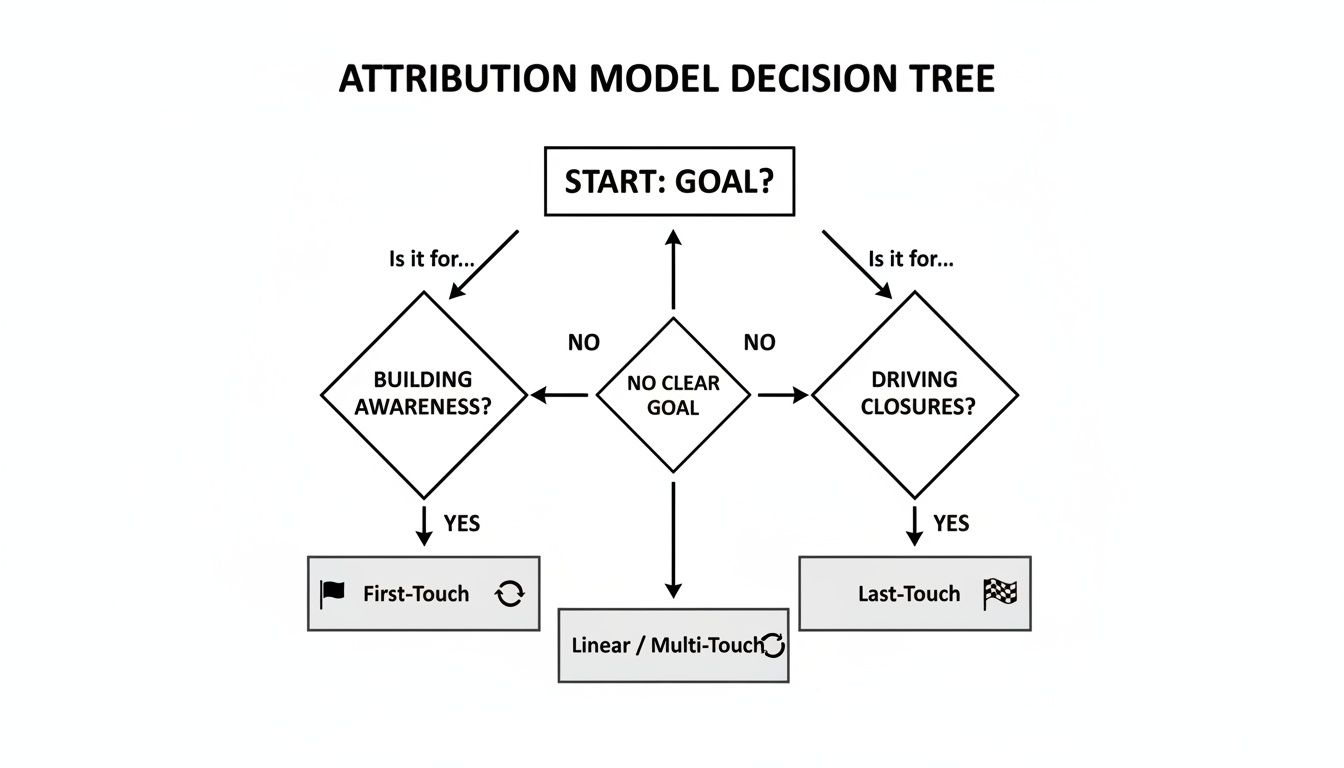
As you can see, if awareness is your game, you need to value the start of the customer's journey. If closing deals is what matters most, then the end of that journey is what you need to focus on.
Consider Your Sales Cycle Length
Your goals are one piece of the puzzle; the other is the length and complexity of your customer's journey. A model that works perfectly for a quick, impulsive e-commerce purchase will be completely useless for a six-month B2B sales process with multiple decision-makers.
If you have a short, simple sales cycle—where a customer might see an ad and buy within the same day—a single-touch model like First-Touch or Last-Touch often gets the job done. The path is so direct that giving all the credit to one key moment is usually accurate enough to give you solid, actionable insights.
But when you're dealing with a long, winding customer journey—common in B2B or for big-ticket items—you need a much more sophisticated view.
For lengthy sales cycles, single-touch models don't just give you incomplete data—they can be actively misleading. They completely ignore the crucial nurturing process that happens between that first hello and the final handshake.
In these scenarios, multi-touch models give you a far more honest picture:
- Time-Decay: This is a fantastic choice for longer consideration periods. It gives some credit to the entire journey but correctly weights the more recent touchpoints that likely tipped the scales and pushed the prospect to make a decision.
- Position-Based: This balanced approach is ideal if you believe the first introduction and the final closing touchpoint are the most important, but you still want to acknowledge the value of the nurturing steps in the middle.
- Data-Driven: If you have enough conversion data to feed it, this is the gold standard. It takes the guesswork out of the equation entirely, using your own performance data to figure out which touchpoints are actually the most influential.
Ultimately, choosing an attribution model is a strategic decision that will define how you measure marketing success. Start by aligning your choice with your core business goals and the reality of your customer journey. That's how you'll unlock the clarity you need to make smarter, data-backed decisions that actually move the needle.
Putting Attribution Into Practice (Without the Code)

This is where the theory of multi-channel attribution modeling meets the real world. For a lot of marketers, just thinking about implementation sparks a headache. It brings up visions of wrestling with complex code, confusing Google Tag Manager setups, and sending an endless stream of requests to the dev team.
The good news? That's the old way of doing things. Modern attribution tools have completely changed the game, making it possible for anyone to capture powerful marketing data without writing a single line of code.
These no-code solutions were built for the non-technical marketer who just wants to know what's working. They handle all the complicated stuff behind the scenes so you can focus on strategy, not scripts.
How No-Code Attribution Tools Work
Think of it like having a smart assistant that follows every visitor around your website, taking notes on exactly how they got there. That's pretty much what a no-code attribution tool does. It all happens in a few simple, automated steps.
Capturing the Data: The second a visitor lands on your site, the tool starts working, automatically grabbing all the important marketing data. This includes details like the traffic source (Google, Facebook, etc.), the specific campaign they came from, and even the keyword they searched.
Storing the Information: This info is then tucked away in the visitor’s browser inside a small file called a cookie. This keeps the data attached to them as they click around your site—from the homepage to a blog post and over to your pricing page.
Passing It to Your Forms: When that visitor finally decides to fill out a form—whether it's on Webflow, WordPress, or Typeform—the tool grabs the stored data and slips it into hidden fields you've added. The visitor never even sees it happen.
This whole process is seamless. It ensures that every single form submission comes loaded with the complete story of how that lead found you.
The big idea behind no-code attribution is simple: it captures the data you need and puts it exactly where you need it—your CRM—without you having to do any technical heavy lifting.
From Your Website Form to Your CRM
The final step is the most satisfying. Once a form is submitted, all that rich attribution data travels right alongside the lead’s contact info and lands directly in your CRM, like HubSpot or Salesforce.
All of a sudden, a new lead record is so much more than just a name and an email. It’s a complete story. You can see the exact journey that brought them to your doorstep, with every touchpoint clearly laid out. For a practical look at how different models are applied, check out this Attribution Model Case Study.
Instead of a new lead record showing a vague source like "Direct" or "Unknown," you'll see details like this:
- First Touch Channel: Organic Search
- Last Touch Channel: Paid Social
- Campaign: Q4 LinkedIn Promo
- Keyword: "b2b marketing software"
This level of detail is a true game-changer. It turns your CRM from a simple contact list into a powerful engine for marketing insights. You can finally build reports that connect your marketing activities directly to new leads and, more importantly, to revenue. To get this right, you need a solid foundation. Our guide on UTM parameter best practices can help with that.
Why This Matters for Modern Marketers
There's a reason why these accessible, powerful attribution tools are taking over. Research shows that a staggering 80% of marketers are unhappy with their current attribution solutions. The old systems just can't keep up with today's messy, fragmented customer journeys.
For a long time, marketers had to rely on simple models like first-touch, which is still the go-to for 44% of digital campaigns. The problem is, that approach only tells you the very beginning of the story, ignoring all the crucial nurturing that happens along the way.
This is exactly why more advanced models—like the data-driven attribution in Google Analytics 4—have become so important. They analyze the entire path to assign credit based on actual impact. By making multi-channel attribution modeling something everyone can do, no-code tools give marketers the power to make smarter decisions, prove their ROI with confidence, and finally answer that all-important question: "Where are my best customers actually coming from?"
Common Attribution Pitfalls to Avoid
Getting started with multi-channel attribution is a huge leap forward, but it's not a silver bullet. A few common missteps can easily derail your efforts, leaving you with confusing data and leading you down the wrong path. Knowing what these traps are ahead of time will help you sidestep them and get right to the good stuff—the insights that actually grow your business.
One of the biggest blunders is picking a model that just doesn’t make sense for your business. Imagine a B2B company with a six-month sales cycle using a Last-Touch model. They're basically choosing to ignore 99% of the customer's journey. All they see is the final handshake, completely missing the blog posts, webinars, and social media conversations that did all the heavy lifting to build that relationship.
Forgetting About Offline Touchpoints
It’s so easy to get tunnel vision and only focus on digital interactions like clicks and form fills. But what about the sales call that changed everything? Or the networking event where a prospect first heard your name? Or the trade show demo that finally convinced them to buy?
When you ignore these offline touchpoints, you end up with huge holes in your data. If a deal closes right after a fantastic product demo, but your model only gives credit to the email that booked the meeting, you're missing the real story. This mistake causes you to over-invest in some digital channels while completely undervaluing the high-impact, real-world connections that often get deals across the finish line.
The fix is simple, but it requires discipline: make sure your team logs every important offline interaction in your CRM.
- Log every call: Every single phone conversation should be logged as an activity.
- Track event attendance: Make a note of which contacts showed up for a webinar or stopped by your booth at a trade show.
- Record in-person meetings: Document every demo and face-to-face meeting.
By capturing this information, your multi-channel attribution modeling can finally start to paint a complete and accurate picture of what’s truly influencing your customers.
The Trap of Analysis Paralysis
Perhaps the most frustrating pitfall of all is going through the trouble of collecting all this amazing data and then… doing nothing with it. You can build the most sophisticated attribution model on the planet, but if the insights it produces just sit untouched in a dashboard, they’re completely useless.
The point of attribution isn't just to make pretty charts; it's to make smarter decisions. Data without action is just noise.
The best way to avoid this is to set up a regular meeting to review your attribution reports. Go into that meeting with one goal: find one or two things you can actually do differently. Start with simple questions like, "Which channel is bringing in our most valuable customers?" or "If we had an extra $1,000 to spend, where should it go?"
Don't wait for perfect data to take action. Start with the insights you have now and make small, deliberate changes. This iterative process is what turns your data from a static report into a powerful tool for constant improvement, ensuring your hard work on attribution actually translates into real business growth.
Frequently Asked Questions
When you start digging into attribution modeling, a few questions always seem to pop up. Let's tackle some of the most common ones to clear things up so you can get started with confidence.
Key Attribution Questions Answered
What’s the difference between multi-channel and multi-touch attribution?
You’ll hear these two terms thrown around, sometimes even interchangeably, but there's a small difference. "Multi-channel" looks at the big picture—how much credit should go to SEO vs. PPC vs. social media. "Multi-touch" zooms in on the specific interactions within those channels.
In reality, though, any good attribution system today does both. It tracks the channels and the individual touches to give you a complete view of the customer's journey.
How long does it take to see results?
The good news is you'll start collecting data on new leads the minute you're set up. But to actually see reliable trends, you need to be a little patient.
It’s best to wait for at least one full sales cycle to pass. For most businesses, this means you can start pulling genuinely useful insights within 30 to 90 days.
Remember, the goal isn’t just to collect data points. It’s to collect enough of them to tell a clear story about what’s really moving the needle for your business.
Can I really implement this without being a technical expert?
Absolutely. It used to be that setting up attribution was a job for developers, involving complex setups with tools like Google Tag Manager.
Thankfully, that’s not the case anymore. Modern no-code tools are built specifically for marketers. They connect directly to your website forms and CRM through a simple, one-time setup—no coding skills needed.
Ready to finally see where your leads and customers are actually coming from? LeadPulse connects the dots between your marketing efforts and your CRM, giving you the clarity you need to prove ROI and make smarter decisions. See how it works at https://getleadpulse.com.
Data driven marketing strategy: data driven marketing strategy for growth
Discover how a data driven marketing strategy turns data into actionable insights to boost campaigns and growth.
A Simple Guide to Cross-Channel Marketing Attribution
Understand cross-channel marketing attribution without the jargon. Learn how to track every lead from every channel and see what's truly driving your growth.