Solving Marketing Attribution Challenges for Good
If your marketing data feels like a puzzle with missing pieces, you're not alone. We call this "marketing attribution"—it's simply the process of connecting a result, like a new customer or a sale, back to the specific marketing effort that made it happen.
The problem is, those connections break all the time. These are the attribution challenges that make it so tough to prove what’s actually working.
Why Is Marketing Attribution So Hard to Get Right?
Think of a customer's journey like a road trip. They might see a billboard (a social media ad), hear a radio spot (a podcast mention), and then grab a map on their phone (an organic search) before finally pulling into your driveway. Marketing attribution is supposed to be the GPS log that tracks every turn they made.
But that log is almost always incomplete. Maybe the radio signal cut out, or they switched cars halfway through the trip. This is the heart of the issue with modern attribution. You can clearly see they arrived—the sale—but the exact path they took to get there is foggy at best.
This isn't just a small headache, either. It’s a widespread problem, with over 80% of marketers admitting they struggle to stitch together data from all their different tools. This pain is even worse for smaller businesses that can't just buy a six-figure enterprise software to solve it, leaving them to manually piece everything together. You can find more insights on this in the latest reports on the state of attribution.
Without a clear map, you’re basically driving blind. You can't tell which roads are leading customers to you, so you end up spending money on shiny billboards no one sees while completely ignoring the side street that’s secretly sending you all your best customers.
This lack of clarity has real consequences for your business. When you can’t confidently connect your efforts to results, you risk:
- Wasting Your Budget: Pouring money into ad campaigns that feel busy but aren’t actually bringing in any revenue.
- Missing Opportunities: Failing to double down on channels that are quietly performing well, like organic search or word-of-mouth referrals, because you can't see their impact.
- Struggling to Prove ROI: Making it nearly impossible to show your boss or stakeholders which marketing initiatives are truly growing the company.
Getting a handle on these common attribution challenges is the first step. Once you know where and why your data is breaking down, you can start building a much clearer picture of what's really driving your business forward.
The Seven Most Common Attribution Roadblocks
To get attribution right, you first have to play detective. You need to understand exactly where and why your data is breaking down, and that means getting to know the usual suspects responsible for muddying your reports.
Let’s dig into the seven biggest roadblocks that trip up marketers every day. We’ll look at what causes them, how they mess with your reporting, and why they make it so hard to see the full story from first click to final sale.
This visual shows the heart of the problem: you run a marketing campaign, but a data gap opens up, obscuring the path between your effort and the revenue it generates.
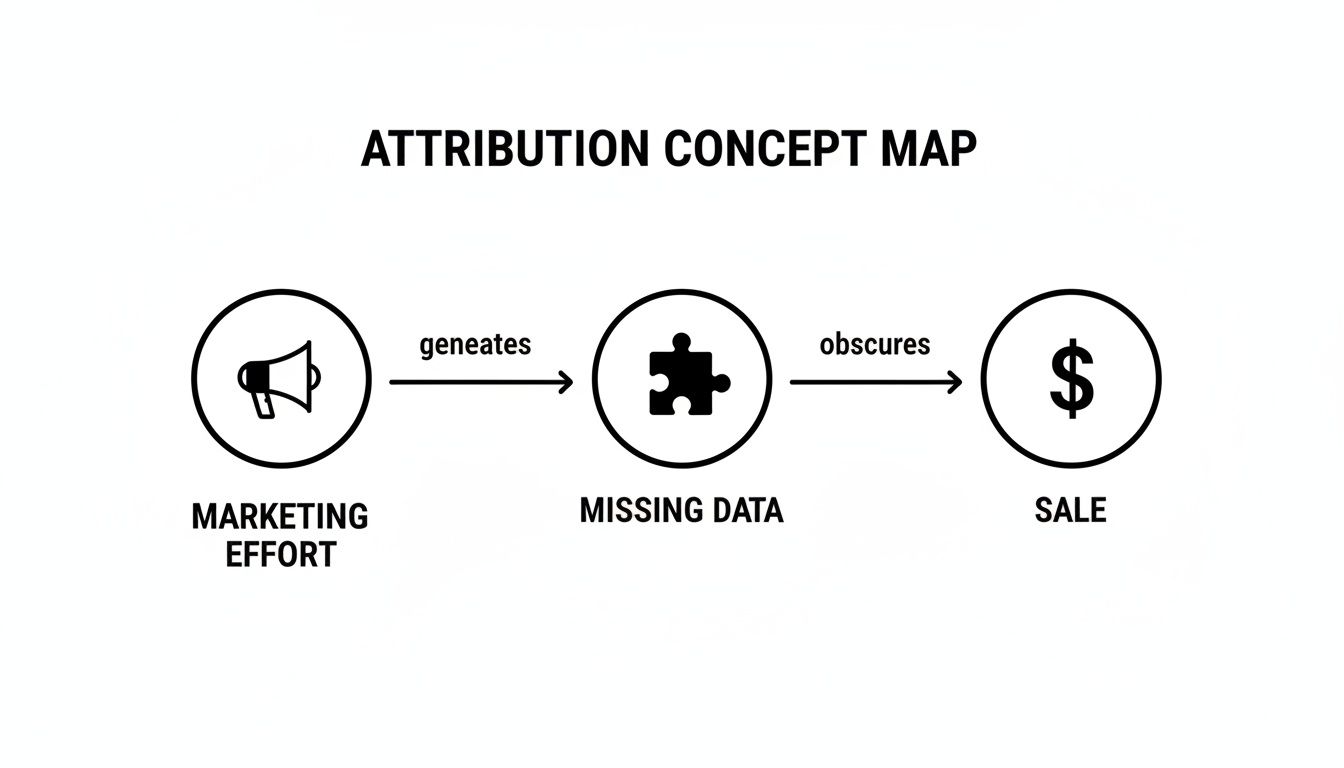
This gap is where all of our attribution headaches live. It’s what stops you from drawing a straight line from your marketing spend to your bottom line.
1. Missing UTM Data
Think of UTM parameters like putting a "return to sender" sticker on a letter. If that sticker falls off in transit, the post office has no idea where the letter originally came from. It's the same with your marketing links.
When UTMs are missing or inconsistent—maybe a team member forgot to add them or used a different naming format—a lead from a specific Facebook ad just looks like they came from "Facebook" in general. Even worse, they often get lumped into "Direct" traffic, completely hiding their true origin.
2. Cross-Device Tracking Gaps
A modern customer's journey is rarely on a single device. Imagine someone sees your Instagram ad on their phone during their morning commute, browses your site on their work laptop at lunch, and finally makes a purchase on their tablet at home that evening.
To most analytics tools, that looks like three separate visitors, not one person on a connected journey. This fragmentation is a massive problem because the initial discovery on mobile gets zero credit for the final sale. The dots are never connected.
3. Cookie Restrictions and Privacy Changes
Tracking cookies used to be like a friendly hotel concierge who remembered you every time you visited. They knew your name, your preferences, and what you looked at last time. But with new privacy laws and browser updates from companies like Apple and Google, those concierges are losing their jobs.
Browsers are increasingly blocking the third-party cookies that let you recognize visitors across different sessions. It's as if every visitor now shows up wearing a disguise, making it nearly impossible to link their past actions to their current visit and eventual conversion.
4. Tracking Offline Conversions
This is a classic blind spot. Let's say a customer sees your Google Ad for a new office desk, visits your website to look at the options, but then decides to call your sales team to place the order.
Your digital reports show a website visit from Google Ads, but no sale. That revenue is completely disconnected from the ad that drove it. This happens constantly for businesses that close deals over the phone, in person, or through manual invoices sent via email.
Your CRM might show a new customer, but it will have no idea that your $2,000 ad spend was the reason they called. Without a system to bridge this online-to-offline gap, you're flying blind on a massive piece of your ROI puzzle.
5. The Mystery of Dark Social
"Dark social" isn't as sinister as it sounds. It simply refers to all the untrackable ways people share content. Think about the last time you texted a link to a friend, or copied and pasted a URL into a Slack channel or a WhatsApp group.
When your friend clicks that link, analytics tools can’t see where they came from—the source is "dark." As a result, this incredibly valuable word-of-mouth referral gets dumped into the "Direct" traffic bucket. It looks like your friend just typed your website address straight into their browser, hiding the true journey.
6. Lost Referral Sources
Referral traffic is gold. It happens when another website links to yours, sending a visitor your way, much like a trusted friend recommending a great restaurant. Normally, your analytics can see which "friend" (the referring website) sent the new customer.
But simple technical glitches can break this connection. For instance, if a visitor clicks a link from a secure https site to your non-secure http site, that referral information is often stripped away during the redirect. The visitor arrives, but the credit for the referring website vanishes. It becomes yet another victim of the dreaded "Direct" traffic category.
7. Multi-Touch Attribution Ambiguity
Finally, we arrive at the most complex challenge of all. A real customer journey can involve dozens of touchpoints. A prospect might see a tweet, click a paid ad a week later, read three of your blog posts, get an email, and then finally type your name into Google and convert.
So, who gets the credit?
- First-Touch: Gives 100% credit to the first tweet they saw.
- Last-Touch: Gives 100% credit to the final organic search.
- Linear: Divides credit equally among all touchpoints.
Most tools default to a last-touch model, which completely ignores all the hard work your other channels did to warm up and nurture that lead. Honestly, choosing the "right" model is confusing, and without a clear view of every single touchpoint, you're really just guessing.
To help you keep track, here's a quick summary of these common issues.
Common Attribution Challenges and Their Impact
| Attribution Challenge | What It Looks Like in Your CRM | Impact on Your Business |
|---|---|---|
| Missing UTM Data | Leads show up as "Direct" or from a generic source like "google". | You can't tell which specific ads, campaigns, or content are working. |
| Cross-Device Tracking | One person appears as multiple different leads with no connection. | You misinterpret the customer journey and undervalue top-of-funnel channels. |
| Cookie Restrictions | Repeat visitors are treated as new, and past interactions are lost. | It's harder to track nurturing efforts and understand the full sales cycle. |
| Offline Conversions | A new customer appears with no marketing source data attached. | You're blind to the ROI of campaigns that drive phone calls or in-person visits. |
| Dark Social | Word-of-mouth referrals are incorrectly labeled as "Direct" traffic. | You drastically underestimate the impact of social sharing and brand advocacy. |
| Lost Referral Sources | Legitimate referral traffic from other sites shows up as "Direct." | You miss opportunities for partnerships and can't credit your backlinks properly. |
| Multi-Touch Ambiguity | The lead source is just the last click, ignoring all prior marketing touches. | You might cut budget from channels that are critical for awareness and nurturing. |
Each of these challenges creates frustrating data gaps. When you can't trust your data, you can't confidently decide where to invest your time and money.
How Data Gaps Skew Your Marketing ROI
Attribution problems aren't just a technical headache; they actively sabotage your ability to make smart marketing decisions. When your data is incomplete or wrong, you get a dangerously warped view of what's working, and that directly messes with your return on investment (ROI).

The biggest red flag is usually a bloated "Direct" traffic channel in your analytics. This bucket becomes a black hole for all the leads your tools can't trace—think dark social shares, lost referrals, or offline phone calls. It looks like tons of people are just magically typing your URL into their browser, but the truth is, it’s just a catch-all for untrackable journeys.
The Real Cost of Bad Data
This distortion isn't just a small inaccuracy; it has serious consequences. When "Direct" traffic looks like a star performer, you’re left guessing what’s actually driving those leads. This makes it almost impossible to justify your budget for channels that are harder to measure but still incredibly valuable.
For instance, your organic social media efforts might be creating fantastic word-of-mouth buzz, but if that traffic gets dumped into the "Direct" bucket, you have zero proof of its impact. Getting a handle on this requires a clear view of the customer's path, and implementing B2B customer journey mapping is a great place to start.
The pressure on marketers today is intense. We're all expected to run more campaigns on more channels, all while budgets get tighter. When your attribution is fuzzy, showing ROI to your boss becomes a nightmare, especially for things like organic search, social, and referrals. Without proof of what's driving revenue, every channel starts looking like a cost instead of an investment.
A Story of Misguided Investment
Let’s look at a real-world example. Imagine a B2B software company that spends thousands every month on Google Ads. Their analytics dashboard clearly shows that paid search is their #1 source of qualified leads, while organic search seems to be doing very little. Based on this data, they make what seems like a logical choice: they double their ad spend and pull back on SEO and content.
Six months later, their cost per lead has shot through the roof, and overall growth has flatlined. They're scratching their heads, wondering why their "most effective" channel is suddenly so expensive and inefficient.
The real problem was buried in their attribution gaps. After digging deeper, they discovered that their best customers were actually finding them through organic search first. They’d read a few blog posts, get familiar with the brand, and then, weeks later, search for the company name and click an ad to finally sign up.
Because their system only looked at the very last touchpoint, Google Ads got 100% of the credit, completely ignoring the critical role SEO played at the start of the journey. They were starving the channel that was actually generating their most valuable leads and pouring money into the one that was just closing the deal. This is why understanding the entire journey, including things like offline conversion tracking, is essential for getting an accurate picture of your ROI.
Practical Ways to Improve Your Attribution Today
Fixing your marketing attribution doesn't mean you have to buy some massive, complicated piece of software. You can make a huge dent in the problem right now just by being a little more intentional about your processes.
Let's walk through a few practical, low-tech ways to get more clarity from your data. They might take a bit of manual work upfront, but the payoff is well worth it. The idea is to plug the holes you have today with the tools you already use.
Standardize Your UTM Naming Convention
So many attribution headaches start with messy UTMs. If everyone on your team creates them differently—one person uses "Facebook," another uses "facebook.com," and a third uses "FB"—your analytics reports become a complete mess. It's impossible to get a clear picture when your data is all over the place.
The fix is surprisingly simple: create a single, standardized naming convention for the entire company. Think of it as a universal language for tracking your links.
One of the easiest ways to get this rolling is with a shared spreadsheet. Just create a simple template with columns for utm_source, utm_medium, and utm_campaign. You can even use dropdown menus to give your team pre-approved options to choose from. This little bit of structure ensures every link is clean, consistent, and ready for analysis.
A Simple UTM Structure to Follow:
- Source: The platform where the traffic is coming from (e.g.,
google,facebook,linkedin). - Medium: The type of marketing channel (e.g.,
cpc,organic_social,email). - Campaign: The name of your specific marketing effort (e.g.,
q4_black_friday_sale).
By getting everyone to follow a simple, documented system, you'll immediately see fewer leads mysteriously bucketed under "Direct" or "(not set)." It’s a tiny change in your process that leads to a massive improvement in data quality.
Add a "How Did You Hear About Us?" Field
When in doubt, just ask! Sometimes the most direct solution is the best one. Adding a simple "How did you hear about us?" field to your forms is a fantastic way to get attribution data straight from the horse's mouth.
This little question is great for catching the sources that automated tools always miss—things like word-of-mouth referrals, podcast shoutouts, or conversations at a trade show. It fills in the gaps by letting your customers tell you what actually brought them to your door.
Of course, this method isn't foolproof. There are a few downsides to keep in mind:
- Fuzzy Memory: People often can't remember the very first place they saw you.
- Vague Answers: You'll get a lot of unhelpful responses like "online" or "Google."
- Last-Touch Bias: Most people will credit the last thing they did, not the original touchpoint that started their journey.
Even with these flaws, this field adds a valuable layer of human insight that helps you connect the dots. To take this a step further, you can learn more about using hidden fields in your forms to capture some of this data automatically.
Create Basic CRM Workflows
Your CRM is more than just a digital rolodex—it can be a surprisingly effective attribution tool if you set it up right. The trick is to create a simple, repeatable process for your team to follow.
Start by adding custom fields in your CRM specifically for lead source information. Then, train your sales or support team to ask every single new contact, "How did you find out about us?" and log the answer in those new fields.
This manual process is perfect for capturing offline conversions, like when someone calls you on the phone or walks into your store. It requires a bit of discipline from your team, but it ensures those valuable leads get credited to the right place, giving you a much more complete picture of what’s actually driving business.
The Automated Solution for Clear Attribution
While those manual fixes can get you started, they often feel like putting a band-aid on a bigger problem. You're constantly chasing down data, reminding your team to fill out fields, and manually cleaning up spreadsheets. It’s a lot of work that pulls you away from what you should be doing: marketing.
But what if you could fix the problem at the source? An automated solution is designed to do just that, giving you reliable data without the daily grind.

This is exactly where a tool like LeadPulse fits in. Think of it as a smart little helper that works silently on your website. After a simple, one-time setup, it automatically figures out where every visitor came from and remembers it.
It’s the ultimate "set-and-forget" answer to your attribution headaches.
How Automated Attribution Works
The beauty of it is how simple it is. You don't need to be a developer to get it working.
- Capture the Source: When someone lands on your site, the tool instantly sees their origin—whether that's an organic Google search, a specific Facebook ad, a post on LinkedIn, or a link from another blog.
- Store the Data: This information is neatly tucked away in the visitor's browser, following them as they look around your site.
- Pass to Your Forms: The moment they decide to fill out a contact form, the tool automatically adds all that valuable attribution data into hidden fields on the form.
- Flow into Your CRM: That data then flows straight into your CRM right alongside the lead's name and email. You get a complete, accurate picture from day one.
This whole process cuts out the human error and guesswork that makes manual tracking so frustrating. No more messy UTMs, no more vague "how did you hear about us?" dropdowns, and no more staring at your reports trying to figure out what actually worked.
Instead of just seeing that a lead came from "Google," you'll know they found you through an organic search for a specific keyword. Instead of a generic "social media" source, you'll see it was the exact campaign you launched on LinkedIn last Tuesday. That’s the kind of detail that changes everything.
Solving Key Attribution Challenges Automatically
An automated tool is built to solve these exact problems. It gives you a clear, trustworthy view of your marketing performance, allowing you to build a powerful marketing attribution dashboard that you can actually rely on.
For instance, it finally clears up the "Direct" traffic mystery. When someone finds you through an organic search but comes back later to convert, their original source is credited correctly instead of being lost. It also makes sure every campaign link is tracked properly, giving you a crystal-clear understanding of what's driving real leads and revenue for your business.
Your Attribution Questions, Answered
Jumping into attribution can feel a bit like peeling an onion—there are always more layers. Let's tackle some of the most common questions that pop up when marketers start trying to get a clearer picture of their data.
What’s the Biggest Attribution Hurdle for Small Businesses?
For most small businesses, the single biggest headache is grappling with incomplete data, especially from organic sources. Think about all the visitors who find you through a Google search, a link on social media, or a referral from another site.
This missing information often leads to a skewed perspective where paid ads get all the glory, while other crucial marketing efforts are undervalued. When you have a tight budget, it's incredibly tough to know where to put your money for the best results. You might end up cutting back on the very channels that are quietly building your brand and bringing in your best leads.
Can I Really Fix Attribution Issues Without Shelling Out for Expensive Software?
Absolutely. You can definitely make a dent in the problem with some solid manual processes. Sticking to a strict system for your UTM parameters and adding a simple "How did you hear about us?" field to your forms can give you some quick wins.
The catch? These methods rely on people getting it right every time, and they just can't automatically piece together the whole customer journey.
A lightweight tool is often the perfect middle ground. It's designed to automate the messy parts of data capture without the overwhelming complexity (or price tag) of enterprise-level software. You get reliable data without the steep learning curve.
How Does Cross-Device Tracking Mess Up My Attribution?
Cross-device tracking is a huge challenge for everyone. Imagine this common scenario: a potential customer sees your ad on Instagram while scrolling on their phone. Later that day, they're on their laptop and decide to search for your brand directly to sign up.
Without a way to link that phone session to the laptop session, your analytics will probably just log the conversion as "Direct" traffic. The original, crucial touchpoint on social media is completely lost. This distorts your data, making your top-of-funnel channels seem way less effective than they actually are.
Ready to finally see where your leads are coming from? LeadPulse captures the source of every lead automatically and sends it straight to your CRM. Get started with LeadPulse today and make smarter marketing decisions with data you can trust.