Data driven marketing strategy: data driven marketing strategy for growth
A data-driven marketing strategy is all about ditching the guesswork. Instead of running on gut feelings and assumptions, you use real customer information to make smart decisions. It’s about figuring out what actually works—like where your best customers come from—and then doubling down on it.
This approach is the key to spending your budget wisely and getting results you can actually measure.
What Is a Data Driven Marketing Strategy

Think about trying to sail a ship across the ocean without a map or a compass. You might hit land eventually, but you'd burn through a ton of time, energy, and supplies getting there. Marketing without data is a lot like that—just a series of hopeful guesses that rarely lead you to the most profitable destination.
A data-driven marketing strategy completely flips that around. It uses hard customer data as its guide instead of relying on hunches. Every decision, from where you spend your money to the words you use in your ads, is backed by real insights from user behavior.
It’s the difference between hoping an ad works and knowing it works because you can trace sales right back to it.
Shifting from Assumptions to Insights
The fundamental idea is pretty simple: connect your marketing activities to real business results. It’s about asking the tough questions and letting the data give you the answers:
- Which social media channel is actually bringing in paying customers, not just vanity metrics like 'likes'?
- Are my Google Ads campaigns generating qualified leads, or am I just paying for expensive clicks?
- Which specific blog post convinced a visitor to finally sign up for a demo?
Answering these questions is how you turn marketing from a cost center into a predictable source of revenue. A great starting point for building a data-driven strategy is to see how platforms like Salesforce for marketers can bring all your data together to streamline campaigns. These tools give you a unified view of every customer interaction, making the entire journey crystal clear.
A data-driven approach isn't about becoming a data scientist overnight. It's about building the discipline to let real performance, not just opinions, dictate your next move.
Here’s a quick breakdown of how these two approaches stack up against each other.
Traditional vs Data Driven Marketing Approaches
| Aspect | Traditional Marketing (Guesswork) | Data Driven Marketing (Informed Decisions) |
|---|---|---|
| Foundation | Relies on intuition, assumptions, and past habits. | Based on real-time customer data and analytics. |
| Campaigns | "Spray and pray" approach with broad targeting. | Highly targeted campaigns aimed at specific audience segments. |
| Budgeting | Budget is allocated based on what "feels" right. | Budget is invested in channels with proven ROI. |
| Measurement | Success is measured with vague metrics like brand awareness. | Success is tied to concrete outcomes like leads and sales. |
| Optimization | Changes are slow and based on subjective feedback. | Campaigns are continuously refined based on performance data. |
As you can see, making the switch is about moving from hoping for the best to building a system for predictable growth.
Why It Matters More Than Ever
Marketing budgets are bigger than ever, so making informed decisions is no longer a "nice-to-have"—it's a must for survival. Global advertising and marketing spend is on track to hit a staggering $1.87 trillion in 2025. With that much money on the line, the businesses that can prove their ROI are the ones that will win.
The payoff is huge. Companies that adopt a data-first mindset often see an 80% increase in return on their media spend over five years. But here’s the catch: over 60% of the marketing data that gets collected is never even used because it’s a disorganized mess. This just goes to show how critical having a clear strategy really is.
This shift lets you move with confidence, knowing every dollar you spend is an investment backed by solid evidence. It's all about systematically improving your results by focusing on what's proven to move the needle for your business.
The Four Pillars of Marketing Success

A successful data driven marketing strategy isn't about complex formulas or needing a PhD in statistics. It really just comes down to four solid pillars. Think of them as the foundation holding up your entire marketing structure, making it strong, stable, and ready to deliver predictable growth.
These pillars create a simple, continuous cycle where each step naturally leads to the next. By following this framework, any business can stop guessing what works and start knowing. It’s a practical roadmap for making smarter decisions that actually move the needle.
Pillar 1: Data Collection
First up is Data Collection, and it's all about gathering the right information. If you try to solve a puzzle with half the pieces missing, you'll never see the whole picture. The goal here is to capture the essential details that tell the story of how a visitor found you and became a lead.
This isn't a license to hoard every bit of data you can find. It’s about being strategic and focusing only on what helps you make decisions.
Key data points to collect include:
- Source: Where did they come from? (e.g., Google, LinkedIn, a partner’s blog)
- Medium: What kind of traffic brought them? (e.g., Organic Search, Paid Social, Email)
- Campaign: Which specific marketing push was it? (e.g., "Summer_Sale_2025")
Nailing this consistently is the first real step toward figuring out where to invest your time and money.
Pillar 2: Data Analysis
Once you've got the data, you move to the second pillar: Data Analysis. This is where you organize and sift through everything you’ve collected to spot patterns. It’s a bit like a detective sorting through clues, looking for a connection no one else has noticed.
You don't need fancy, expensive software for this part. More often than not, your existing CRM has everything you need.
The real point of marketing data analysis isn't to run complex algorithms. It's to answer a simple question: "Where are my best customers actually coming from?"
For instance, you could run a simple report in your CRM that groups new leads by their marketing source. All of a sudden, a pattern jumps out: leads from "Organic Search" are turning into customers way more often than leads from paid ads. That one observation is the perfect bridge to our next pillar.
Pillar 3: Actionable Insights
The third pillar, Actionable Insights, is the "aha!" moment. It's when you turn a pattern in your data into a clear, confident business decision. An insight isn't just an interesting tidbit; it's a discovery that practically screams for action.
Let's stick with our example. The analysis showed that your organic search leads are gold.
- The Data: Leads from organic search close at a 20% rate.
- The Insight: Our content and SEO efforts are clearly attracting a better-fit audience than our paid campaigns are.
- The Action: We need to double down on SEO and create more content that speaks directly to our ideal customer's problems.
This is the very heart of a data driven marketing strategy—letting hard evidence, not just gut feelings, guide your next move.
Pillar 4: Measurement and Iteration
Finally, we close the loop with the fourth pillar: Measurement and Iteration. This is where you check if your data-backed decision actually paid off. It's about being accountable to the results and constantly tweaking your approach for the better.
So, after you shifted more of your budget to SEO, you'd track your key metrics for the next quarter.
Did the number of qualified leads from organic search go up? Did your overall customer acquisition cost drop? The answers fuel your next round of decisions. This creates a powerful feedback loop where every action makes your marketing smarter and more effective, turning your strategy into a self-improving engine for growth.
How to Capture Marketing Data That Actually Matters
A solid data driven marketing strategy lives or dies by one thing: knowing exactly where your best leads come from. Yet, this is the exact spot where most businesses completely fall apart. A great prospect might click a Google ad, read a blog post, and finally fill out your contact form—but by the time their details land in your CRM, that crucial origin story is often completely gone.
This gap creates a massive blind spot in your marketing. If you don't know which channels are delivering qualified leads, you're right back to making decisions based on guesswork, not evidence. The key to closing this gap is capturing marketing attribution data—the digital breadcrumbs a user leaves behind on their journey.
The Mystery of the Missing Attribution Data
Let’s play this out. Imagine you're running a paid ad campaign on LinkedIn. You’ve done everything right, meticulously setting up your UTM parameters to track the source, medium, and campaign. A visitor clicks your ad, lands on your site, loves what they see, and fills out your form. Success!
Well, not quite. The moment they hit "submit," all that incredibly valuable UTM data often just vanishes into thin air. Your CRM logs a new lead, but the all-important context of how they found you is gone. This happens because most standard web forms simply aren't built to capture and pass that information along.
This is probably the single biggest headache for most marketers. You end up with a CRM full of leads and no real idea if it was your SEO efforts, paid ads, or social media that actually brought them in.
Bridging the Gap From Form to CRM
So, how do you actually fix this? The old-school answer involved clunky workarounds with Google Tag Manager or custom code to grab this data and store it in cookies. Honestly, it was a huge pain—brittle, time-consuming, and way too technical for most marketers and business owners.
Luckily, there’s a much simpler way now. Modern attribution tools are designed to work quietly in the background, automatically capturing key data points for every single person who visits your website.
These tools grab all the good stuff, like:
- UTM Parameters: The specific campaign, source, and medium that brought the visitor.
- Referral Source: The website that linked to yours (e.g., a partner blog or an industry directory).
- Channel Data: Broader categories like Organic Search, Paid Social, or Direct traffic.
This information is then stored and automatically passed into hidden fields you can add to the web forms you already use. When a lead fills out a form, all that rich attribution data flows directly into your CRM right alongside their name and email. It’s a true ‘set it and forget it’ solution that finally closes the loop without needing a developer.
The goal isn’t just to collect data; it’s to make that data effortlessly available right where you make decisions—inside your CRM.
Setting Up Your Data Capture Workflow
Getting this up and running is surprisingly straightforward. The process usually just involves adding a small snippet of code to your website one time. From that moment on, the tool does all the heavy lifting, giving you a crystal-clear picture of every lead's journey from their very first touchpoint to the final conversion.
Once you have this data flowing, you can finally build reports that answer the marketing questions that actually matter. You can confidently see which Google Ads campaign is driving the most demo requests or which blog post is generating the most high-quality leads. This level of visibility is what turns your data driven marketing strategy from a nice idea into a practical, revenue-generating machine.
Of course, quantitative data is just one piece of the puzzle. To get a truly complete picture, you also need to understand the "why" behind the numbers. Combining attribution with qualitative feedback is a powerhouse move. Learning how to collect customer feedback effectively will give you a holistic view of your audience that data alone can't provide.
And if you want to make sure your tracking links are structured for maximum clarity from the get-go, check out our guide on UTM parameter best practices.
Making Smarter Decisions with Your Data
Getting clean, reliable marketing data into your CRM is a huge win, but it’s really just the starting line. The true magic of a data driven marketing strategy happens when you start turning that raw information into smarter, faster business decisions. This isn't about getting bogged down in complex spreadsheets or needing a degree in statistics; it's about asking the right questions and letting your data point you toward clear, profitable answers.
The whole point is to stop just collecting data and start using it to actively steer your strategy. Instead of guessing which marketing efforts are actually paying off, you can build simple, repeatable ways to know for sure. This helps you focus your precious time, budget, and energy on the things that are proven to grow your business.
This diagram shows the all-too-common journey of a lead, highlighting exactly where critical marketing data often gets lost before it can ever be used.
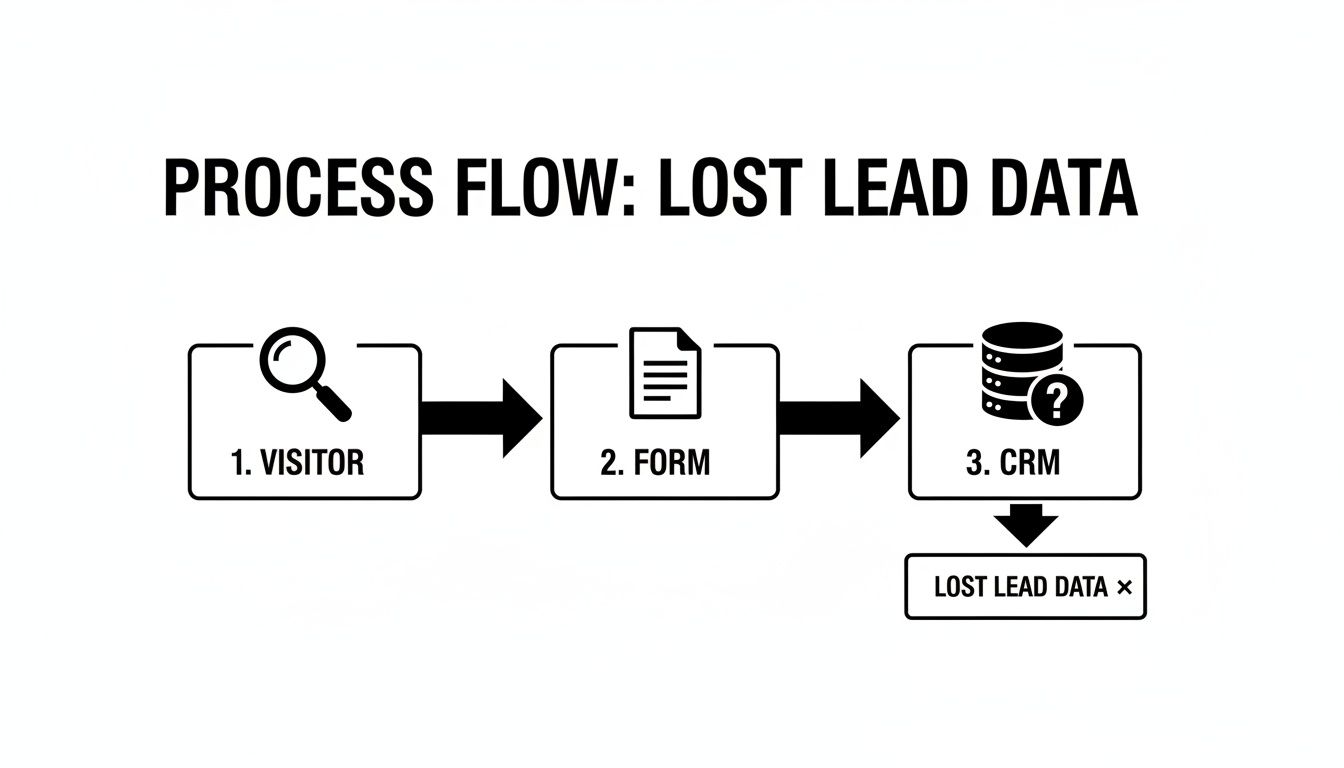
Without a system to connect the dots, the link between a person's first visit and their entry into your CRM is severed. When that happens, you're left flying blind about what’s actually working.
To put your data to work, you need a clear idea of what you're looking for. The table below outlines some of the most common and valuable questions your CRM data can help you answer, guiding you on where to look and what to do with the insights you find.
Key Questions Your Marketing Data Can Answer
| Business Question | Data Point to Check in Your CRM | Potential Action |
|---|---|---|
| Which of my marketing channels is the most valuable? | Group leads/customers by "Original Source" or "UTM Source". | Double down on the top-performing channel; reduce or re-evaluate the budget for underperformers. |
| Are my paid ads actually profitable? | Compare the "Cost Per Lead" from your ad platform with the "Lead-to-Customer" conversion rate in your CRM. | Optimize ad campaigns that deliver high-quality leads and pause those that don't. |
| What kind of content generates the best leads? | Look at the "First Page Visited" or "Landing Page" data for your best customers. | Create more content around the topics and formats that are proven to convert. |
| Is my SEO effort paying off in real business terms? | Filter leads by "Organic Search" and see how many become qualified opportunities or customers. | Identify your top lead-generating keywords and pages to inform your future SEO strategy. |
| How long does it typically take for a new lead to become a customer? | Calculate the average time between "Create Date" and "Close Date" for won deals. | Adjust your follow-up cadences and sales cycle expectations based on real data. |
By starting with these questions, you can quickly find actionable insights that lead to real-world improvements in your marketing performance.
Performing a Channel Performance Review
One of the most powerful, yet simple, exercises you can do is a Channel Performance Review. Think of it as a reality check right inside your CRM to see which marketing channels are your true workhorses. It cuts through vanity metrics like clicks and traffic to focus on what actually brings in real leads and customers.
Getting started is easy. Just create a simple report that groups all your new leads from the last 90 days by their marketing channel (e.g., Organic Search, Paid Social, Direct, Referral).
Once you have that, ask these three crucial questions:
- Which channel brought in the most total leads? This gives you a quick read on volume.
- Which channel produced the most qualified leads or sales? This is the money question, as it reveals quality over sheer quantity.
- What’s our cost per lead for each channel? If you're running paid ads, this tells you how efficient your spend is.
The answers will immediately sort your winners from your duds. You might find that while your paid ads bring in a ton of leads, organic search delivers leads that are 50% more likely to become customers. That's a game-changing insight you can act on right away.
Conducting a Content ROI Check
Every piece of content on your website—from blog posts to landing pages—should be treated like a business asset. A Content ROI Check helps you pinpoint which assets are your conversion machines and which are just collecting dust. This is where having that detailed attribution data really pays off.
By tracking the 'Landing Page' or 'First Page Visited' for every new lead, you can draw a straight line from a specific piece of content to a new business opportunity.
A surprising number of businesses discover that 80% of their leads come from just 20% of their content. Finding and optimizing that top 20% can have a massive impact on your growth.
Pull a report in your CRM that shows which blog posts or pages people viewed right before they filled out a form. You might discover a single, in-depth guide is responsible for a huge chunk of your demo requests. This tells you exactly what to do next: create more content on similar topics, update and promote that winning post, or feature it more prominently on your site.
This is the essence of a data driven marketing strategy. Of course, understanding how different channels and touchpoints work together is also a big piece of the puzzle. To go deeper on that, check out our guide on cross-channel marketing attribution.
By using simple frameworks like these, you turn your CRM from a glorified contact list into a strategic engine for growth. You can confidently shift your budget, prioritize your team's efforts, and build a marketing machine that gets predictably better over time.
Common Marketing Stumbles and How to Sidestep Them
Switching to a data-driven marketing strategy is a game-changer, but it’s not always a smooth ride. It’s pretty common to hit a few bumps in the road that can throw off even the best plans. The good news? These issues are easy to see coming and even easier to fix once you know what you're looking for.
Spotting these pitfalls early on is the secret to building a strategy that actually works. Think of them less as failures and more as learning moments that will make your marketing smarter in the long run.
Stumble 1: Analysis Paralysis
One of the first hurdles marketers face is what I call "analysis paralysis." You’ve done the hard work of getting data flowing into your CRM, but now you’re staring at a mountain of it. With dozens of reports and endless metrics, it’s easy to feel so overwhelmed that you do nothing at all.
If you feel stuck, it’s a sure sign you’re trying to boil the ocean. Remember, the data is supposed to make your job easier, not more complicated.
The Fix: Start by asking one simple, high-impact question. Forget about analyzing everything at once. Just focus on a single question that has a direct line to business growth. A great one to start with is: "Which marketing channel brought us our best customers last month?" This cuts through the noise and forces you to focus on what really moves the needle, turning that data mountain into a single, useful insight.
Stumble 2: Chasing Vanity Metrics
It's incredibly tempting to get fixated on numbers that look great on a dashboard but don't actually impact the bottom line. These are "vanity metrics"—they stroke the ego but don't measure what truly matters. We're talking about things like social media likes, page views, or even email open rates.
These numbers aren't totally useless, but they don't tell you if your marketing is actually making money. A blog post that gets 10,000 views is nice, but if it didn't bring in a single real lead, did it really do its job?
The goal of a data-driven marketing strategy isn't just to get more clicks or followers; it's to get more customers. Real success is measured inside your CRM, not on a social media report.
The Fix: Connect every single marketing activity to a real business result. Shift your focus to metrics that show customer acquisition and revenue, such as:
- Leads by Source: Which channels are actually sending you inquiries?
- Customer Conversion Rate by Campaign: Which campaigns are best at turning those leads into paying customers?
- Customer Lifetime Value (CLV) by Channel: Which sources bring in the customers who stick around and spend the most?
When you prioritize metrics like these, you know your effort is always pointed toward actual growth.
Stumble 3: Acting on Incomplete Data
The last major stumble is making big decisions with only half the story. This happens all the time when crucial attribution data—like where a lead truly came from—gets lost before it ever makes it into your CRM. You might see a lot of leads coming from "direct traffic" and think your brand is a powerhouse, when in reality, those people first found you through a paid ad a week ago.
Making decisions with these kinds of data gaps is like trying to drive with a map that’s missing most of the roads. You’re bound to make a wrong turn.
The Fix: Get a reliable system in place to capture the entire customer journey. This means finding a tool that automatically grabs all that important attribution data and pipes it straight into your CRM. When you do this, you can be confident that the information you're using to make budget decisions is complete and accurate, allowing you to invest in the channels that are genuinely driving your business forward.
Putting Your Data-Driven Strategy into Action

Theory is great, but seeing a data-driven marketing strategy actually work in the real world is what really matters. Let's get out of the weeds of concepts and look at a couple of tangible stories where businesses used simple data to get some serious wins. These examples prove you don't need a huge team or a massive budget to start making smarter moves.
These aren't just hypotheticals; they're quick, powerful case studies showing how a focused approach can turn your marketing from a guessing game into a reliable growth engine.
The B2B Startup That Doubled Demo Requests
Imagine a small B2B software company pouring money into Google Ads but feeling like they were just lighting cash on fire. Their CRM was filling up, which looked good on the surface, but they couldn't tell which campaigns, ad groups, or keywords were bringing in the leads that actually turned into customers.
The Problem: The team was flying blind. They were spending money without knowing what was working, suspecting that a huge chunk of their budget was wasted on keywords that got clicks but never converted into a real conversation.
The Solution: They did something surprisingly simple. They started using a basic attribution tool that grabbed the UTM parameters from every ad click. This data was then automatically pushed into hidden fields on their demo request form and sent straight to their CRM. Just like that, every single new lead was tied directly back to the exact campaign and keyword that brought them in.
The Result: After just one quarter of tracking this, a lightbulb went on. They saw that 80% of their best, most qualified demos were coming from just a few specific, long-tail keyword campaigns. They immediately paused the duds, shifted that budget over to the winners, and doubled their monthly demo requests—all without spending a single extra dollar.
This story gets to the heart of it: You can't improve what you don't measure. Gaining that visibility is always the first, most critical step.
The Marketing Agency That Boosted Client ROI by 50%
Here’s a common one. A marketing agency was struggling to show clients the true value of their organic social media and content marketing. They could point to traffic spikes and engagement numbers, but they couldn't connect the dots from a specific LinkedIn post to a new paying customer. This made justifying their monthly retainer a tough conversation.
The Problem: The agency was stuck reporting on "vanity metrics." They lacked the hard evidence to prove their top-of-funnel work was actually generating bottom-line results for their clients.
The Solution: They brought in a proper analytics tool to track where every lead was coming from, including organic social media and referrals from their blog posts. This finally allowed them to build reports that drew a straight line from their content efforts to the exact number of leads—and revenue—generated.
The Result: Armed with clear, data-backed reports, the agency could finally prove their worth without a shadow of a doubt. They demonstrated a 50% increase in client ROI directly from their work, which not only secured their retainers but also helped them upsell clients on bigger content packages. For any agency in this position, exploring what a modern marketing analytics platform can do is a great next step.
Frequently Asked Questions
Jumping into data-driven marketing can feel a little intimidating. You're busy running a business, not trying to become a data scientist. Here are some of the most common questions I hear, with simple, straightforward answers.
Do I Need to Be a Data Expert for This to Work?
Absolutely not. For most of us, getting data-driven isn't about building complex statistical models. It’s about answering one simple, powerful question: “What’s working?”
The whole point is to get practical insights. By using tools that automatically figure out where your leads are coming from, you can just look at your CRM and see which channels are actually paying off. It's less about advanced analysis and more about making confident decisions with clear evidence.
What Are the Most Important Metrics to Track?
It’s easy to get bogged down by vanity metrics like website traffic or social media likes, but they rarely tell you what you really need to know. For any business focused on growth, it boils down to two things:
- Leads by Source: Which marketing channels—like a specific Google Ad, an organic search, or a referral partner—are actually bringing people to your door? This tells you what’s filling your pipeline.
- Customers by Source: This is the metric that truly matters. It shows you which of those channels are bringing in paying customers, helping you see your real return on investment.
Focusing on these two core metrics cuts through the noise. They directly connect your marketing spend to revenue, which is the key to making smart budget decisions and scaling your business effectively.
How Can I Track Leads Without Technical Skills?
This is a huge hurdle for many people, but the solution is much simpler than you might think. The most reliable way is to use a marketing attribution tool built for people who aren't developers.
These tools usually have a simple, one-time setup that doesn't require any coding or fiddling with Google Tag Manager. Once it’s active, the tool quietly works in the background, capturing attribution data for every visitor. It then pushes that info into your web forms, so it flows right into your CRM. It’s a true “set it and forget it” approach that finally closes that frustrating data gap.
Ready to finally see where your leads and customers are actually coming from? LeadPulse automatically captures marketing attribution data and sends it to your CRM, giving you the clarity you need to make smarter marketing decisions. Know what channels are driving your growth.
Customer Journey Mapping Tools: 12 Best Options for Marketers
Explore the top customer journey mapping tools for marketers. Compare features, pricing, and integrations to map your customer experience quickly.
A Simple Guide to Multi Channel Attribution Modeling
Finally understand where your leads come from. This guide simplifies multi channel attribution modeling for non-technical marketers using common forms and CRMs.